

Client
Our client rang us from Dubai on a Sunday, which is a working day there, having been put in touch by an existing client of ours in the same office. British, mid-forties, seven years in the UAE with a logistics firm, salary paid in dirhams into a local bank account.
He already had two buy-to-let flats in the UK in his own name, both bought before he left, both on standard single lets, and he had never missed a payment on either.
Background
The flats were doing fine but not much more than that. After the last remortgage the yield on each had drifted down to a little under five per cent gross and he was fed up with it. A friend in Nottingham had been running a licensed HMO for a few years and the numbers he was quoting were roughly double.
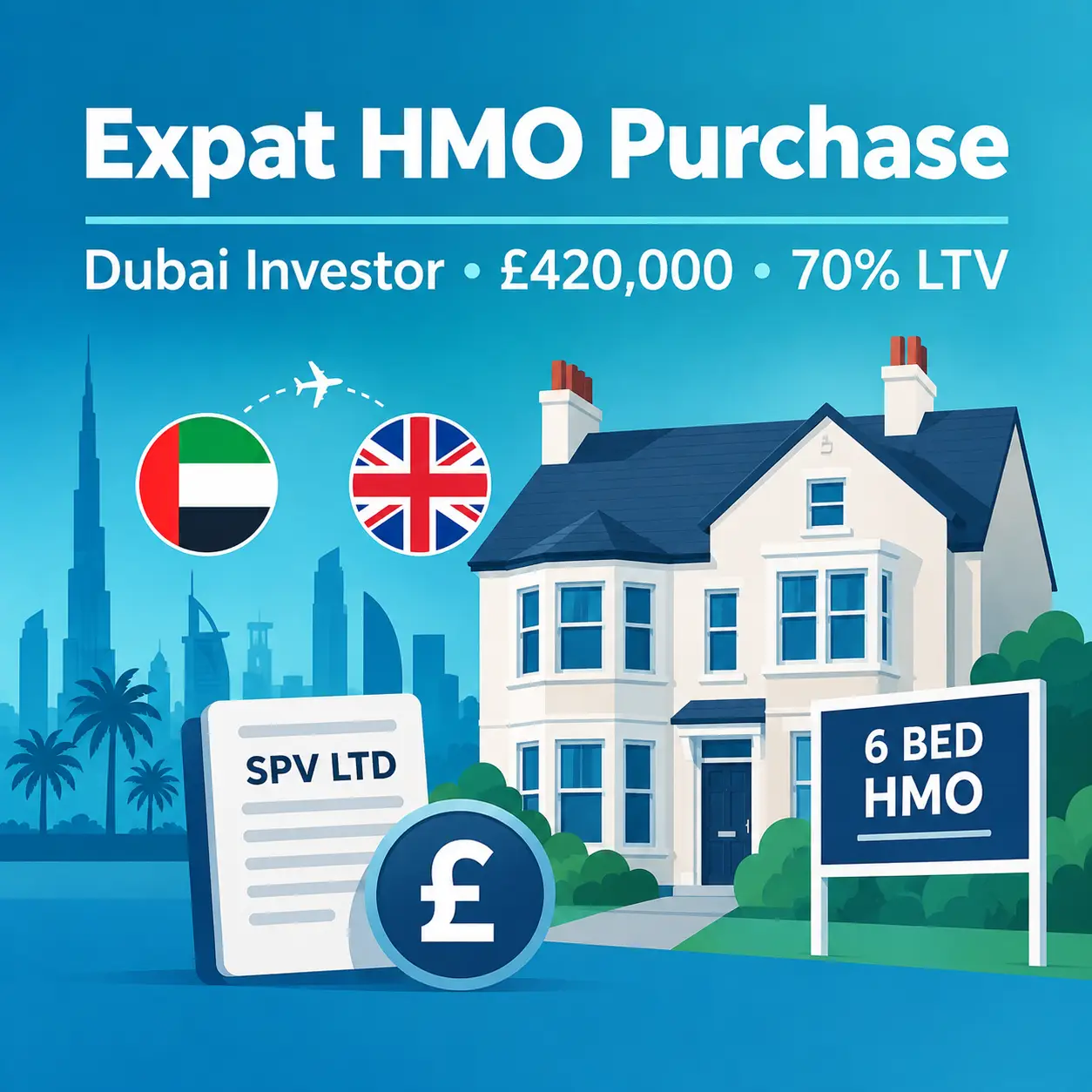
So the client went looking, and found one. A six-bedroom licensed HMO in the East Midlands, already let room by room, all six occupied, asking price £420,000. The sitting rent came to £4,200 a month, £50,400 a year.
He also wanted to stop buying in his own name. His accountant had told him to set up a limited company for anything new, so he had incorporated an SPV in the UK about three weeks before the offer went in. Correct SIC codes, him as sole director and shareholder, and absolutely nothing else in it. No bank account yet, never mind accounts.
Requirement
- Purchase price: £420,000
- Deposit: £126,000, which is 30 per cent
- Mortgage: £294,000 at 70 per cent loan-to-value
- Property: six-bedroom licensed HMO, fully let
- Rent: £4,200 a month, £50,400 a year
- Borrower: a UK SPV incorporated three weeks earlier
- Director and guarantor: British expat living in Dubai
- Product wanted: a limited company expat HMO mortgage, five-year fixed if the pricing was sensible
Challenges
I will be honest, when he first described the deal I could think of perhaps six lenders who might look at it, and by the time we had been through the detail it was two.
The HMO on its own rules out the high street. Six rooms is over the threshold where a lot of the specialist lenders start applying their larger-HMO rules too, which tends to mean a lower LTV or a bigger valuation haircut. Then there is the Dubai address. Plenty of lenders will do expat buy-to-let now, far fewer will do expat HMO, and a couple of those have the UAE on a list of countries they do not lend into at all, for reasons that have nothing to do with the borrower.
The company was three weeks old. Most lenders in this space do not mind that as such, but one of the two we had left wanted the deposit sitting in a company bank account before the application, and the company did not have one yet.
And then management. He had been looking after the two flats from Dubai himself, with a handyman in the UK who he paid by bank transfer when something went wrong. That works for a single let. It does not work for a six-bed HMO with a licence, fire regulations and tenants changing every few months, and no lender offering HMO mortgages to expats that I know of will accept it.
The rent was never the issue. £50,400 against £294,000 of borrowing is comfortable on anyone’s stress test. But rent does not get you past a lender who has already said no to your postcode.
Solution
We did the paperwork first and the application second, which sounds obvious but is the opposite of what most people do.
The property was straightforward. We got the HMO licence from the council’s register, the six tenancy agreements from the selling agent, and a rent schedule showing what each room actually paid rather than what the agent said it could achieve. Two of the rooms were slightly under the advertised figure, so the £4,200 was real money, not a projection.
For the company we opened a business bank account, which took eleven days, and had the client transfer the £126,000 deposit into it from Dubai in one movement so the trail was a single line. His accountant put together a one-page director’s loan agreement to go with it.
For the borrower we pulled together seven years of UAE payslips, the last six months of Dubai bank statements, the mortgage statements on the two existing flats and a UK credit report. He had kept a UK bank account and a credit card active while abroad, which helped more than he realised.
Management was the piece we had to build. We introduced him to a lettings agent in Nottingham who runs about forty HMOs and has dealt with expat landlords before, and the management agreement was signed before the mortgage application went in rather than after, so the lender saw it as a fact rather than a promise.
We then went to both remaining lenders for a decision in principle on the same day. One came back in four days at 70 per cent with a five-year fix, the other took a week and offered 65. We went with the first.
Outcome
Mortgage offer came through five weeks after the application, subject to the valuer confirming the HMO configuration and the licence, which he did. Completion was nine weeks from the offer being accepted, which for an expat SPV HMO is about as quick as it gets.
The SPV now owns a £420,000 six-bedroom HMO with a £294,000 mortgage at 70 per cent LTV on a five-year fixed rate, all six rooms let, producing £50,400 a year gross, with the client’s personal guarantee sitting behind the company’s borrowing and a Nottingham agent handling everything on the ground. The client has since asked us about moving one of the two flats into the same company.
Summary
A British expat living in Dubai bought a £420,000 six-bedroom licensed HMO through a UK SPV that was three weeks old at the time of the offer, borrowing £294,000 at 70 per cent LTV with professional UK management arranged before the application.
Key Point
If you live abroad and want a UK HMO through a company, the order matters. Get the management agent, the company bank account and the deposit trail sorted before anyone applies for anything, because the lenders who will look at this deal are few enough that you cannot afford to burn one on a half-prepared application. And do not assume that good rent will carry the case. It will not get you past a residency exclusion or a missing management arrangement.
Frequently Asked Questions
Can an expat get a mortgage on a UK HMO?
Yes, but from a short list of specialist lenders rather than the wider expat buy-to-let market.
The lender has to be happy with the HMO and with your country of residence at the same time, and a few of them exclude particular countries outright, so where you live can matter as much as the property.
Can an expat buy an HMO through a limited company?
Yes, some of the lenders that do expat HMO will lend to a UK SPV with an overseas director.
Expect them to underwrite you personally as if you were the borrower, and to ask for a personal guarantee from every director and any shareholder over about 25 per cent.
How much deposit does an expat need for an HMO mortgage?
Usually 25 to 35 per cent, and the bigger the HMO or the less popular your country of residence, the nearer the top of that range you will be.
This client put in 30 per cent, £126,000 on a £420,000 purchase, and borrowed £294,000 at 70 per cent LTV.
How do lenders assess the rent from an HMO?
They take the total of the room rents and stress it against the mortgage interest at a notional rate, typically a couple of points above the actual rate.
The important thing is that they want the rooms let at those figures, not just a valuer’s opinion of what they might achieve. Here the six rooms brought in £4,200 a month, which cleared the test easily.
Do I need a UK managing agent if I live overseas?
For an HMO, treat it as compulsory.
Six tenants, a licence, fire safety checks and regular inspections are not something a lender will let you run from another time zone, and in this case the management agreement was a condition of the offer.
Can a newly formed SPV get an expat HMO mortgage?
Yes. The lender is not interested in the company’s history because it has none; it is interested in yours.
Your income, your credit file, your landlord track record and where the deposit came from are what get the case through, and the company just needs to be set up properly with the right SIC codes and a bank account.
If you have any questions relating to an expat HMO mortgage, contact us today to speak directly with one of our specialist expat Mortgage Advisors.
Expat Mortgages UK is a specialist broker directly authorised and regulated by the Financial Conduct Authority. We work exclusively with expats and foreign nationals buying UK property with overseas income.
Your property may be repossessed if you do not keep up repayments on a loan secured against it.
The Financial Conduct Authority does not regulate some forms of buy-to-let mortgage.
Call: +44 1494 622 555 Email: info@expatmortgages-uk.com
Related Pages
- HMO mortgages for expats and foreign nationals – how HMO lending works for overseas investors, from licensing to lender criteria.
- UK mortgages for expats in Dubai – mortgage options for British expats living and working in Dubai.
- UK mortgages for UAE expats – lending for expats across the wider UAE.
- Expat mortgage calculator – estimate what you could borrow on a UK property.
- Expat mortgage case studies – more real client outcomes from Expat Mortgages UK.